
Painting in the Wake of Artemis II
- Apr 14
- 3 min read
There are moments when humanity quietly crosses a threshold—not with noise, but with perspective.
The Artemis II mission was one of those moments.
For the first time in over 50 years, humans traveled beyond low Earth orbit, circling the Moon and returning home. It was easy to frame it as a technological milestone—and it was—but what stayed with me was something far less tangible: the imagery, and the perspective it returned to us.
Because long before rockets and spacecraft, we were painters of the sky.
The Image That Changes Everything
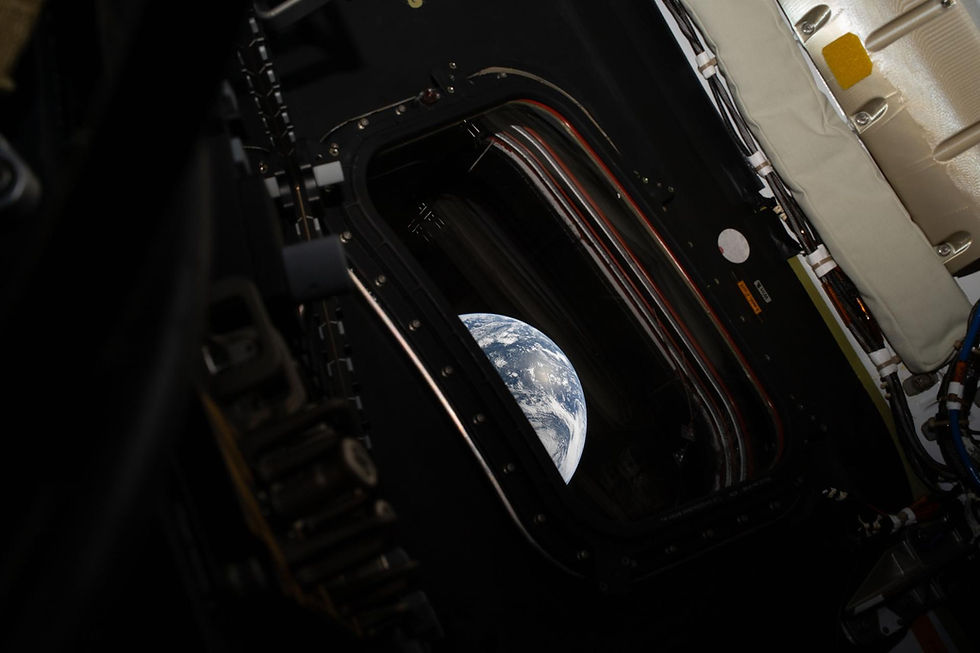
Along its trajectory, Artemis II gave us views that few humans have ever seen with their own eyes: the far side of the Moon, and Earth suspended in the vastness beyond it.
That far side—the hemisphere forever turned away from us—is something we intellectually understand but emotionally rarely grasp. We know it exists. We’ve seen satellite imagery. But seeing it again through human presence, through the lived experience of astronauts, reconnected it to us in a different way.
It became less abstract.
More real.
And then there was Earth.
A small, luminous sphere hanging in the black.
Images like this inevitably echoed the legacy of Apollo 8 Earthrise—a photograph often credited with reshaping how humanity sees itself. That single image helped spark environmental movements, philosophical reflection, and a kind of quiet collective humility.
We are not at the center.
We are together.
Why This Made Me Want to Paint
When I saw these images, I felt something that was difficult to articulate.
It wasn’t just awe. It wasn’t just beauty.
It was a kind of emotional compression. Scale collapsed. Distance became intimate. The infinite became something you could almost hold in your hands.
And that is exactly what painting tries to do.
As an artist, I’m not trying to recreate the image as a camera sees it. I’m trying to translate the feeling of it—what it’s like to confront that level of vastness and still feel tethered to something deeply personal.
The far side of the Moon wasn’t just a landscape. It was a symbol of the unseen—the parts of existence that are always there, but just out of reach.
Earth, glowing in the distance, wasn’t just a planet. It was home. Fragile, unified, and improbably alive.
Painting became a way of holding both truths at once.
The Tension Between Detail and Vastness
One of the things I found myself drawn to after Artemis II was the balance between precision and atmosphere.
Space imagery invites hyper-detail—the craters, the textures, the subtle gradations of light across the lunar surface. But what pulled me in wasn’t just the detail. It was the silence around it.
The negative space.
The darkness that isn’t empty, but infinite.
This is where painting diverges from photography. A photograph can show you what is there. A painting can suggest what it feels like to be there.
After seeing the Artemis II images, I began imagining compositions differently:
The stark geometry of the Moon’s far side
Earth as a distant, luminous counterweight
The overwhelming quiet of space pressing in from all sides
These weren’t just scenes.
They were emotional environments.
A New Era of Perspective
The broader Artemis program wasn’t just about returning to the Moon. It marked the beginning of a sustained human presence beyond Earth, laying the groundwork for deeper exploration.
But for artists—and for anyone willing to pause and look—it offered something else:
A renewed opportunity to see ourselves from the outside.
Every generation gets its own version of this.
For some, it was the first images of Earth from orbit. For others, it was Earthrise. And now, it was Artemis.
And each time, the message remained the same, even if we struggle to hold onto it:
We are small. We are connected. And we are extraordinarily lucky to be here.
Painting as Translation
I don’t see my work as documentation.
I see it as translation.
The Artemis II mission, and the images it brought back, felt like a kind of raw language—light, shadow, distance, silence. My role, as I understand it, is to translate that language into something human. Something felt.
Something that allows someone standing in a room, on an ordinary day, to momentarily step outside of it.
To feel the scale.
To feel the quiet.
To feel the strange, beautiful isolation of Earth in the cosmos.
Looking Back—and Forward
We now have those images.
And they’ve already begun changing how I think about what I want to paint next.
That, to me, is the power of missions like Artemis II. They don’t just expand our physical reach—they expand our inner landscape.
They remind us that there is always more to see.
And more to feel.

Comments